Multi-GPU parallelism
This page provides an overview of running an inference problem on
several GPUs. diff-soup supplies two kinds of parallelism. Data
parallelism splits the experiments of a fit across the devices, and each
device solves its share. Model parallelism splits one simulation across
the devices, so a sparse factorization too large for one GPU is factored
by several. Both are declared through the axes of a device mesh on
ds.Layout (linear solvers).
Throughout, we reuse the three-particle model and its six experiments from
hierarchical fits.
Data parallelism
It is common that many datasets can be naturally partitioned into batches, for example, independent experiments in hierarchical fits or windows in multiple shooting. Under the data parallelism paradigm, these batches are distributed across devices, where each device solves its own batch and the optimizer sums the cost, the gradient, and the curvature across the devices at every step, so the fit is the same as on one device.
mesh = ds.global_mesh(("data",))
layout = ds.Layout(mesh=mesh)

lowered = ds.lower(study, layout=layout)
result = ds.inference.optsolve(lowered, ds.inference.TrustRegion())
ds.global_mesh(("data",))builds a device mesh over every GPU JAX sees, and the experiments are split along itsdataaxis.layout=onds.lowerplaces the experiments on the mesh (pose the joint inference problem). The defaultNoneruns on one device.ds.inference.TrustRegiondrives a study split across devices (run the fit).balance_steps=on the layout moves experiments between devices when one device holds several and their step counts differ. The default enables it whenever a device holds more than one experiment, andFalsekeeps the initial assignment.
Use data parallelism when every batch fits on one GPU and there are at least as many batches as devices. It costs no communication inside a solve.
Model parallelism
One simulation whose sparse factorization outgrows a GPU is factored
across the devices of a model axis. The cuDSS backend factors and solves
each iteration matrix across them, and the time stepper, the consistent
initialization, and the sensitivities all solve against that factor.
mesh = ds.global_mesh(("model",))
problem = spec.build(layout=ds.Layout(mesh=mesh))
sol = ds.pdesolve(problem, ds.JIDA(linear="cudss"), (0.0, 2.0), y0, saveat=ds.SaveAt(ts=ts))
ds.global_mesh(("model",))builds a mesh whose devices share one factorization. It needs the cuDSS backend.spec.build(layout=)declares the placement, and an inference problem posed on the built problem needs nothing further.ds.global_mesh(("data", "model"), shape=(n_data, n_model))declares both axes, so that each experiment is spread overn_modeldevices and the experiments are split overn_datasuch groups.
Model parallelism should be used when the size of the linear solve becomes the primary computational bottleneck, such as for 3D meshes where the fill-in of the sparse factor grows superlinearly. Model parallelism induces communication cost, so it is preferred when the linear solve becomes memory-bound.
Several processes and nodes
Everything above runs in one process on the GPUs of one node, the multi-GPU mode (MG). On a large-scale HPC system a job spans several nodes. diff-soup then runs one process per GPU, and one mesh spans every process, the multi-node mode (MGMN):
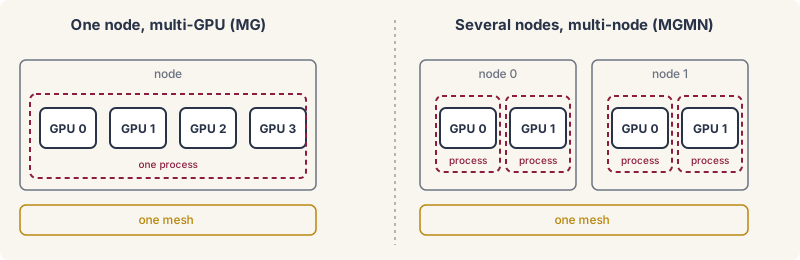
In MGMN mode, model parallelism uses ds.distributed.initialize() and a
mesh whose model axis spans the processes:
ds.distributed.initialize()                      # before any array is created

mesh = ds.global_mesh(("model",))
problem = spec.build(layout=ds.Layout(mesh=mesh))
sol = ds.pdesolve(problem, ds.JIDA(linear="cudss"), (0.0, 2.0), y0, saveat=ds.SaveAt(ts=ts))
ds.distributed.initialize()is called before any array is created. It detects a Slurm launch with one task per GPU, a process started bypython -m diff_soup.distributed.launch, and an MPI launch whenDIFFSOUP_COORDINATORgives process 0'shost:port. Otherwise it takescoordinator_address=,num_processes=, andprocess_id=together, and without a launcher or these arguments it does nothing.- A
modelaxis whose GPUs belong to several processes runs the multi-node cuDSS mode, enabled by settingDIFFSOUP_MGMN=1in the environment of every process. A mesh whosemodelgroups mix one-process and several-process GPUs is refused when the layout is built. - An MGMN program places its arrays on the layout's mesh, for example
jax.device_put(x, NamedSharding(layout.mesh, PartitionSpec()))before the jitted solve.
Data parallelism over several processes uses ds.distributed.run, which
lowers the study and splits its experiments over the processes (fitting
a cohort across an allocation):
with ds.distributed.run(study) as lowered:
    result = ds.inference.optsolve(lowered, ds.inference.TrustRegion())
- Process 0 runs the block, and the other processes evaluate their experiments for it. They exit when the block ends, so results are written inside the block.
- Start it with
mpirun -n K python -m mpi4py script.py. In one process the block runs as written. - A
Measurementwhosevaluesis a function is loaded on the process that owns its experiment (declare the data).
Checkpointing
Large jobs can run for hours to days, and it is best practice to use
checkpointing to protect from job interruption. The diff-soup
checkpointing system, checkpointed_map, is used for independent
experiments and records the state of each finished run as it completes.
from diff_soup.inference.design import checkpointed_map


def fit_particle(item):
    mine = tuple(e for e in experiments if e.id.startswith(item["task_id"]))
    problem = ds.inference.InferenceProblem(mine, parameters=(D, k))
    res = ds.inference.optsolve(problem, ds.inference.NewtonTrustRegion(grad_tol=1e-5))
    return {"D": float(res[D]), "k": float(res[k]), "converged": bool(res.converged)}


items = [{"task_id": "A"}, {"task_id": "B"}, {"task_id": "C"}]
campaign = checkpointed_map(fit_particle, items, ledger_path="particles.json")
campaign.results        # one dict per accepted task, in the order of items
campaign.failures       # the tasks that raised, with their errors
fnis the run, a function of one item returning a dictionary of plain numbers and strings, anditemsthe tasks, each carrying atask_idthat stays the same across restarts.ledger_path=is the JSON file the campaign writes. Each task is written as it finishes, accepted or failed, and the file is replaced as a whole on every write, so an interruption never leaves it half written.resume=True, the default, reads the ledger first, keeps every accepted task, and runs the failed and interrupted ones again. A task whose item changed since it was recorded is refused, so a result is never paired with the wrong input.execution="serial", the default, runs the tasks one after another in this process.execution="processes"places each task on one of the device groups,device_groups=ds.mesh_groups(mesh, (1,) * n)for one GPU per task, and runs it on the processes that own the group.campaign.resultsholds the accepted results in the order ofitems,campaign.failuresthe tasks that raised with their errors, andcampaign.recordsthe status and attempt count of every task.